
Bench Warrants in Taylor County
A bench warrant is court process tied to an existing case. In Taylor County it may follow a missed arraignment, docket, trial, sentencing, or show-cause setting; contempt or another failure to obey a court order can also matter. A fine-only case may involve a capias pro fine after judgment rather than a new probable-cause arrest warrant.
The right office depends on the case. District Court felony settings go through the District Clerk and the assigned court. A/B misdemeanors route through the County Clerk and a County Court at Law. A traffic or Class C matter may belong to a JP or municipal judge. The word “bench” alone does not identify the court or the remedy.
Taylor County Bench Warrants Across Five JP Positions
Taylor County lists five JP judicial positions in four precincts. JP 1-1 and JP 1-2 serve from Abilene; JP 2 is in Merkel, JP 3 in Tuscola, and JP 4 in Lawn. The county says JPs handle fine-only matters and may issue search and arrest warrants. A missed traffic or Class C setting may therefore belong to a JP even when the person lives inside a city.
Use the court printed on the citation rather than choosing by address alone. The JP court list gives each position’s contact route.
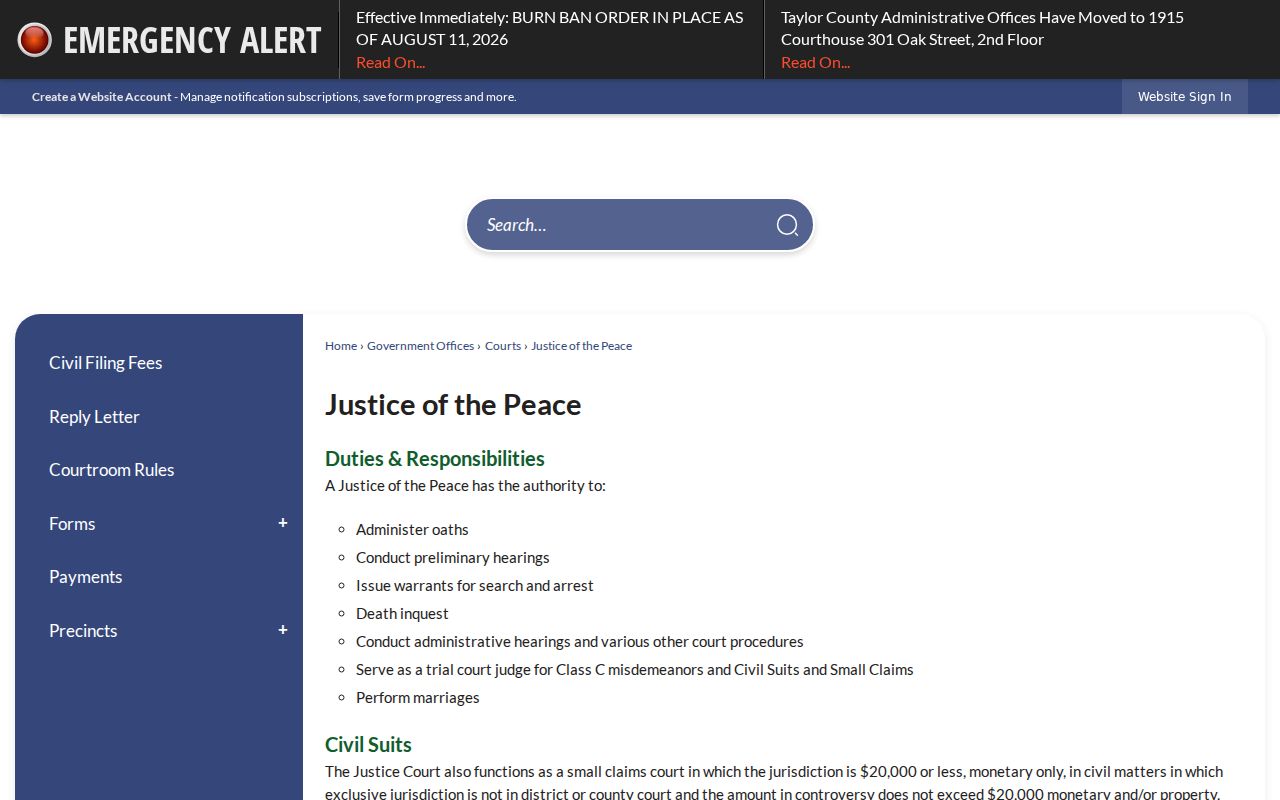
These precinct offices hold different dockets; one JP’s search cannot clear a warrant issued by another court.
How a Taylor County Bench Warrant Is Issued
A judge reviews the missed obligation and may issue process under the rules that govern that case. Once issued, the warrant is recorded by its court and sent for service through the relevant law-enforcement channel. The sheriff, a constable, a city marshal, or city police may execute an assigned warrant; the court decides whether it is recalled.
There is no single public Texas active-warrant database to check next. A city or JP docket may not appear in the county’s selected Odyssey records. If the file is in a County Court at Law, the A-K/L-Z assignment can help identify which clerk and judge to contact.
Taylor County’s Missed-Sentencing Rule
County Court at Law #2 publishes a specific consequence for a missed return date for sentencing: the existing bond may become insufficient, and a warrant and possible contempt issue can follow. Its rules also describe a seven-day courtesy notice to the bondsman after a missed appearance. That notice is a local court rule detail, not a countywide grace period or permission to miss another setting.
The rules for CCL #2 apply to its cases. Ask the court listed on the notice whether it has a reset process or a show-cause setting.
Taylor County Bench Warrant vs Arrest Warrant
A bench warrant responds to a missed court duty in an existing case. An arrest warrant generally follows a probable-cause review tied to an alleged offense. Both can authorize arrest, but the issuing court, record, and path to resolve them differ. See Taylor County arrest warrants for the probable-cause process.
| Feature | Bench Warrant | Arrest Warrant |
|---|---|---|
| Trigger | Missed date, contempt, or failure to comply. | Probable cause tied to an offense. |
| Who Issues It | Judge handling the pending case. | Judge or magistrate after the required review. |
| Underlying Case | An existing case with a missed duty. | A criminal charge or investigation. |
| How It Clears | Follow the issuing court’s appearance, recall, or quash process. | Ask about counsel, bond, appearance, or a court motion. |
Abilene Bench Warrant Alias and Capias Triggers
Abilene City Marshals uses “alias warrant” for a failure to appear and “capias warrant” for a guilty judgment followed by failure to comply with the court order. A capias pro fine is a separate post-judgment process for fine-only court matters. These terms can sound alike, but the missed date, judgment, and court determine what the person must do.
Ask Abilene Municipal Court which event is on the file. A sheriff check or payment vendor cannot decide whether the municipal judge has withdrawn the warrant.
How to Resolve a Taylor County Bench Warrant
Start by confirming the issuing court, case number, warrant type, and any bond or payment instruction. The Taylor County Sheriff warrant-check FAQ gives the in-person status route; it does not replace the issuing judge or decide recall. A lawyer can ask for a reset or motion to recall or quash, or help arrange a voluntary appearance. For a fine-only judgment, ask the JP or municipal clerk about a payment plan, hardship hearing, community service, or other option allowed by the court.
- Locate the case in the issuing court’s file or ask the clerk to confirm its status.
- Ask whether the court requires a new setting, a show-cause hearing, payment, bond, or a lawyer-filed motion.
- Bring identification, the citation or cause number, and proof of any payment or completed condition.
- Get written confirmation of recall and ask when the sheriff, constable, or portal will receive the update.
Caution: A missed setting can affect bond and lead to service; ask the issuing court or a lawyer about the next required step.
Taylor County Clerk Records Do Not Recall Warrants
The County Clerk keeps Class A and B misdemeanor records, split between Court at Law #1 for A-K surnames and Court at Law #2 for L-Z. The clerk’s own page says it does not issue or withdraw arrest warrants, even though the office coordinates with the jail and law enforcement and processes certain misdemeanor payments.
Use the clerk to locate the county-court file; ask the judge or court administrator about a warrant. The misdemeanor records page explains the split.
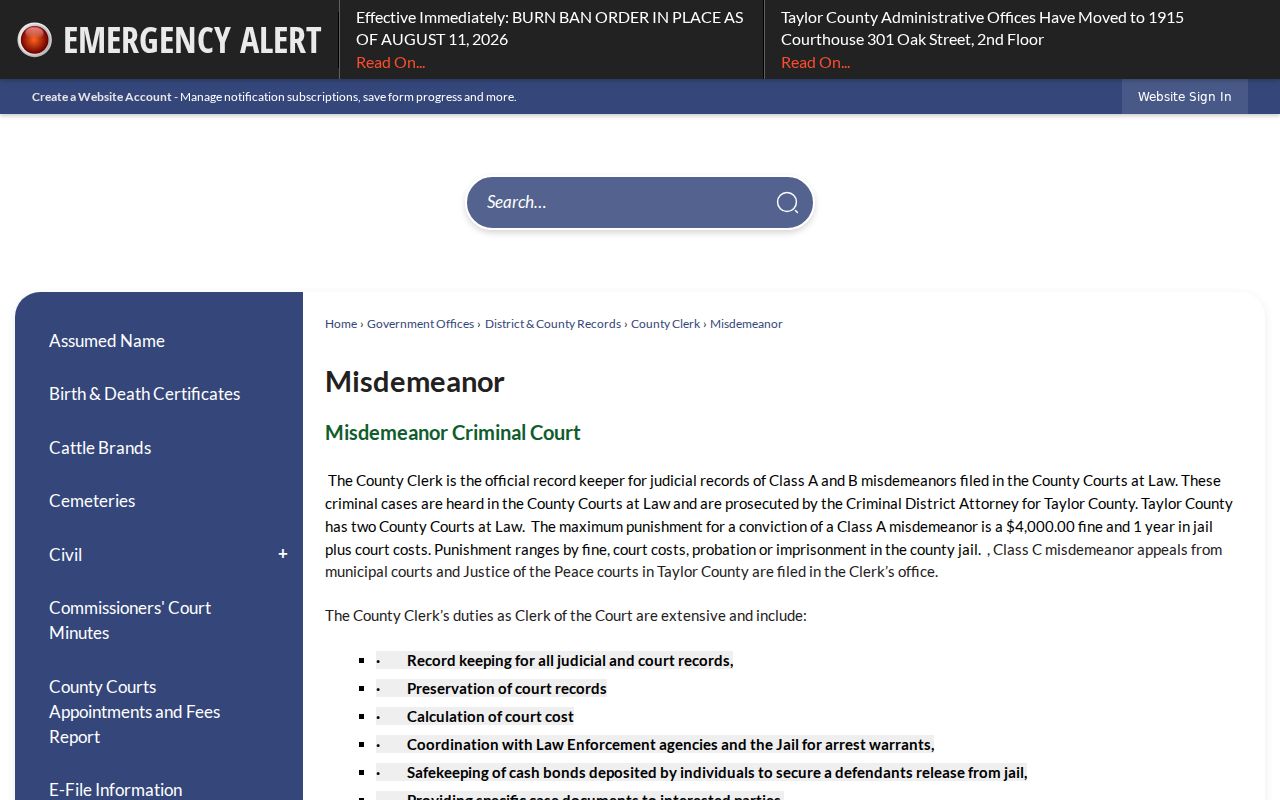
Keep a payment receipt, but also obtain confirmation from the court that controls the warrant.
Which Taylor County Court Issued It
A warrant stays under the control of the court that issued it. The sheriff or constable may serve the order, but cannot decide whether to recall it. Read the cause number, court name, and citation to identify the right clerk. Taylor County felony files route to district court; A/B misdemeanors route to the County Clerk and a County Court at Law.
For lower-level matters, check the JP or city listed on the citation. Taylor County’s warrant search steps explain the sheriff, Odyssey, JP, and municipal routes. Ask the clerk what proof the court needs after an appearance or payment, and retain the written answer.
Taylor County PR Bond Is Not Automatic in Court at Law #2
County Court at Law #2 says ordinary personal-recognizance release is seldom allowed and that a request may be referred to the Court Supervised Release Program. The published program cost is three percent of the bond amount. That rule is specific to its courtroom and is not a universal Taylor County bond schedule.
Ask the issuing court or counsel whether the rule applies to the case and what other release terms exist. No general county bond amount or warrant surrender window was located.